
Category: System Administration

  • How to decode CSR (Certificate Signing Request) ?

    How to decode CSR (Certificate Signing Request) ?

    What is CSR?

    Certificate Signing Request
    Certificate Signing Request is encrypted piece of code which is going to used for generating the SSL Certificate for your domain name.


    CSR contains the information about Country, State, Location, Organisation Name, Common Name ie Domain Name , Email Address and Public Key.

    Lets see how to extract the information from the CSR file?

    How to extract information from the CSR?

    surya@x ~/ » openssl req -in blog.suryaelite.com.csr -text -noout

    How to verify the signature of CSR?

    surya@x ~/ » openssl req -in blog.suryaelite.com.csr -noout -verify

    To which company certificate is issued to?

    surya@x ~/ » openssl req -in blog.suryaelite.com.csr -noout -subject

    How to extract Public Key from CSR?

    surya@x ~/ » openssl req -in blog.suryaelite.com.csr -noout -pubkey

    This is how you can extract the various information from the CSR file.

  • AWS – NDB – Ubuntu – Add separate location for MySQL temporary (tmp) storage

    AWS – NDB – Ubuntu – Add separate location for MySQL temporary (tmp) storage

    aws_mysql_disk_addition

    By default MySQL uses the system default location used for temporary file storage, which is usually /tmp/var/tmp, or /usr/tmp. In Ubuntu its /tmp. It’s good practice to specify separate location for MySQL, if you want to prevent System restart. If tmp location is on separate location then only MySQL restart will needed in case of any disk increase needed in future.

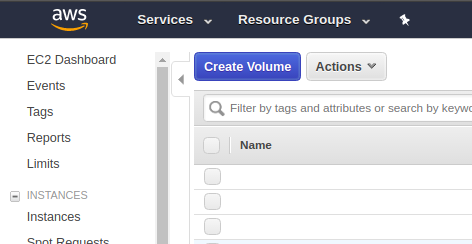
    Step 1: Create new EBS Volume by Login to Console and Click on EC2 Dashboard, then click on “Volumes”
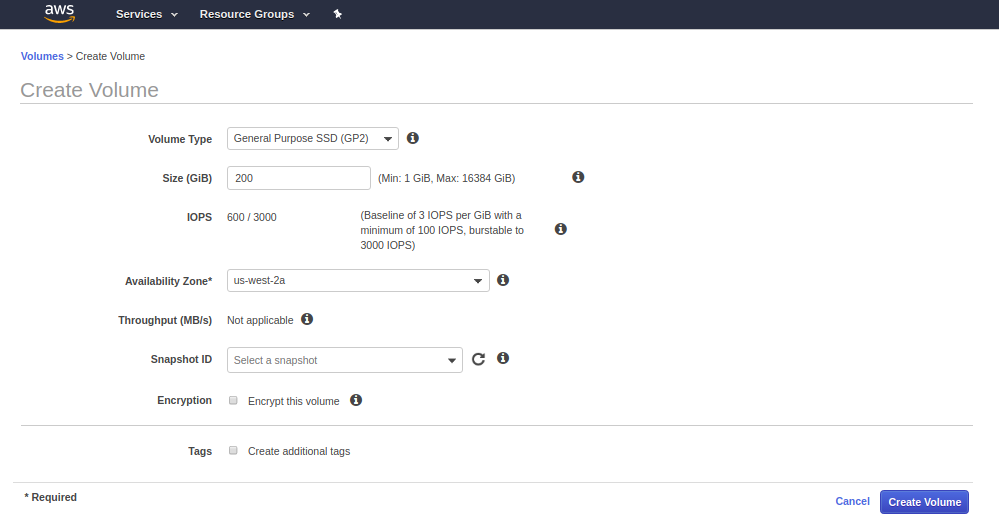
    Step 2: Fill the details of Volume and click on create and the new Volume will be created within few seconds.
     

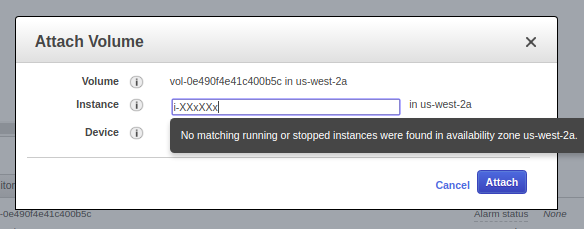
    Step 3: Attach the newly created volume to the Instance.
    Step 4: Check if the volume is attached or not by going to EC2 dashboard and clicking on that particular instance. You can also check by going to Volume stats as well.

    Step 5: Login to machine by your key or password.

    Step 6: Format Volume to ext4 and then mount it and make fstab entry as well.

    root@x:/mnt: lsblk
    NAME    MAJ:MIN RM   SIZE RO TYPE MOUNTPOINT
    xvda    202:0    0    40G  0 disk 
    └─xvda1 202:1    0    40G  0 part /
    xvdb    202:16   0   400G  0 disk /mnt/data
    xvdf    202:80   0   200G  0 disk 
    
    
    root@x: mkfs.ext4 /dev/xvdf
    mke2fs 1.42.9 (4-Feb-2014)
    Filesystem label=
    OS type: Linux
    Block size=4096 (log=2)
    Fragment size=4096 (log=2)
    Stride=0 blocks, Stripe width=0 blocks
    13107200 inodes, 52428800 blocks
    2621440 blocks (5.00%) reserved for the super user
    First data block=0
    Maximum filesystem blocks=4294967296
    1600 block groups
    32768 blocks per group, 32768 fragments per group
    8192 inodes per group
    Superblock backups stored on blocks: 
        32768, 98304, 163840, 229376, 294912, 819200, 884736, 1605632, 2654208, 
        4096000, 7962624, 11239424, 20480000, 23887872
    
    Allocating group tables: done                            
    Writing inode tables: done                            
    Creating journal (32768 blocks): done
    Writing superblocks and filesystem accounting information: done     
    
    
    root@x: mkdir /mnt/xvdf
    root@x:/mnt: sudo mount /dev/xvdf /mnt/xvdf/
    root@x: mkdir /mnt/xvdf/tmp_mysql
    root@x:/mnt/xvdf# chown -Rf mysql:mysql /mnt/xvdf/tmp_mysql
    root@x:/var: ln -s /mnt/xvdf/tmp_mysql/ /var/tmp_mysql
    

    Step 7: Now put the tmp_dir setting in /etc/my.cnf

    [mysqld]
    tmpdir = /var/tmp_mysql
    

    Step 8: Restart the MySQL and check for setting by Login to MySQL and executing below mentioned Query

    root@x:/: sudo service mysql restart


    mysql> SHOW VARIABLES LIKE 'tmpdir';

    This is how you can change the temporary directory in AWS hosted Ubuntu Linux environment.


  • Ubuntu 16.04 – Cisco VPN Client installation

    Ubuntu 16.04 – Cisco VPN Client installation

    cisco_vpn_client

    On Ubuntu 14.04 only sudo apt-get install network-manager-vpnc was working. But for Ubuntu 16.04 you need to install network-manager-vpnc-gnome as well.

    Step 1: Open Terminal
    Step 2: run below command to install the cisco client

    sudo apt-get install network-manager-vpnc network-manager-vpnc-gnome

    Step 3: Click on the “Network Icon” on toolbar, then click “Edit Connections”
    Step 4: Click on “Add” Button
    Step 5: Choose “Cisco Compatible VPN (vpnc)”, click on “Create”
    Step 6: Fill the below details on VPN Tab

    • Gateway: VPN IP 199.229.XXX.XXX
      UserName
    • UserPassword
    • GroupName
    • GroupPassword

    Step 7: Click on Save

    VPN Setup has been completed.

    To connect VPN, click on the Network Icon on toolbar. Click on VPN Connections. Choose the VPN which you have recently created.

    Please make sure, you are on different network to connect VPN.

  • Solution – Apache – SoftException in Application.cpp:388: GID of script “index.php” is smaller than min_gid error

    Solution – Apache – SoftException in Application.cpp:388: GID of script “index.php” is smaller than min_gid error

    apache 500 error

    If you are getting the errors in apache logs like below in cPanel/WHM web hosting

    Error: Apache – SoftException in Application.cpp:388: GID of script “index.php”

    [Mon Oct 02 08:29:33.684683 2017] [core:error] [pid 24787:tid 140323590199040] [client 91.73.173.118:50064] End of script output before headers: index.php
    [Mon Oct 02 08:29:34.812915 2017] [:error] [pid 9068:tid 140323474810624] [client 91.73.173.118:50065] SoftException in Application.cpp:388: GID of script "/index.php" is smaller than min_gid
    [Mon Oct 02 08:29:34.812981 2017] [core:error] [pid 9068:tid 140323474810624] [client 91.73.173.118:50065] End of script output before headers: index.php
    [Mon Oct 02 08:29:34.817808 2017] [:error] [pid 9068:tid 140323474810624] [client 91.73.173.118:50065] SoftException in Application.cpp:388: GID of script "index.php" is smaller than min_gid

    most probably the file user or group ownership has been changed of that file to root.

    root@x.com [directory]# ls -lrt | grep "index.php"
    total 48000
    
    -rw-r--r-- 1 abc_user root         1782 Oct  2 07:10 index.php
    

    Now change the ownership  back to current user is the fix

    Solution: Change the Ownership of file to the  ‘username’ where public_html folder is present.

    Like in /home/abc_user/public_html/ the user will be ‘abc_user

    root@x.com [directory]# sudo chown abc_user:abc_user index.php
    

    This is how you can fix above mentioned problem.

    The above fix will also work for below mentioned error

    Error : Apache Mismatch between target GID (501) and GID (99) of file “index.php”

    [Mon Oct 02 08:30:52.056769 2017] [core:error] [pid 24787:tid 140323474810624] [client 91.73.173.118:51627] End of script output before headers: index.php
    [Mon Oct 02 08:30:52.062511 2017] [:error] [pid 24787:tid 140323474810624] [client 91.73.173.118:51627] SoftException in Application.cpp:456: Mismatch between target GID (501) and GID (99) of file "index.php"
    [Mon Oct 02 08:30:52.062577 2017] [core:error] [pid 24787:tid 140323474810624] [client 91.73.173.118:51627] End of script output before headers: index.php
    [Mon Oct 02 08:30:54.060966 2017] [:error] [pid 24729:tid 140323464320768] [client 154.122.107.180:33276] SoftException in Application.cpp:456: Mismatch between target GID (501) and GID (99) of file "index.php", referer: http://m.facebook.com/


  • Linux – Increase / Resize the Disk Storage in AWS EC2 EBS without reboot

    Linux – Increase / Resize the Disk Storage in AWS EC2 EBS without reboot

    From 13th Feb 2017, there is no need to reboot the EC2 instance for increasing the EBS disk storage.

    Amazon Web Services has announced –

    Amazon EBS Update — New Elastic Volumes Change Everything

    The good news is, EBS modification process is also applicable for root volumes as well. Let’s learn how to do that.

    How to increase the Linux AWS EC2 EBS storage without rebooting?

    • Login to AWS web console
    • Search for EC2 Service in the Console and click on that.

    AWS EC2 Search

    • Click on the EBS on the left menu and search for the volume you wish to modify.
    • Right click on the EBS Volume and click on Resize > Modify Volume

    ebs_modify_size

    • Click on “Modify” button and it will ask for confirmation.

    • Click on “Yes” Button and it will give the confirmation that volume has been modified or not.

    ebs_modification_succeded

    use lsblk to identify the volume information.

    [surya ~]$ lsblk
    NAME    MAJ:MIN RM SIZE RO TYPE MOUNTPOINT
    xvda    202:0    0  30G  0 disk
    └─xvda1 202:1    0  30G  0 part /
    xvdf    202:80   0  20G  0 disk /mnt
    └─xvdf1 202:81   0   10G  0 part

    Now you can see that xvdf has been increased to 20 GB

    now use file system specific commands to increase the volume size on the server.

    for Linux ext2, ext3, or ext4 file system use below commands to increase the volume

    # install "cloud-guest-utils" if it is not installed
    surya:~$ sudo apt install cloud-guest-utils
    
    surya:~$ sudo growpart /dev/xvdf 1
    CHANGED: disk=/dev/xvdf partition=1: start=4096 old: size=16773086,end=16777182 new: size=73396190,end=73400286

    Note: growpart command used when we want to increase a partition within disk. If there is no partition within the disk then use below command to resize the disk.

    resize2fs /dev/xvdf

    Now run lsblk command again to confirm

    [surya ~]$ lsblk
    NAME    MAJ:MIN RM SIZE RO TYPE MOUNTPOINT
    xvda    202:0    0  30G  0 disk
    └─xvda1 202:1    0  30G  0 part /
    xvdf    202:80   0  20G  0 disk /mnt
    └─xvdf1 202:81   0   20G  0 part

    Now run df -h to check the space

    surya:~$  df -h
    Filesystem            Size  Used Avail Use% Mounted on
    /dev/xvda1             70G  951M   69G   2% /
    tmpfs                 1.9G     0  1.9G   0% /dev/shm
    /dev/xvdf             20G   45M  20G   1% /mnt

    This is how you can increase the size of the EBS volume without rebooting the Linux machine.

    For more information please visit AWS Documentation.

  • Linux – How to set default version of PHP in Ubuntu 16.04

    Linux – How to set default version of PHP in Ubuntu 16.04

    It might be possible you have installed multiple version of PHP in you server or system. First you should list all the php version and check which version is set to default. After that set the preferred PHP version.

    How to list number of Php version in the system?

    To list PHP version use sudo update-alternatives --display php

    surya@x:$ sudo update-alternatives --display php
    php - manual mode
      link best version is /usr/bin/php7.1
      link currently points to /usr/bin/php5.5
      link php is /usr/bin/php
      slave php.1.gz is /usr/share/man/man1/php.1.gz
    /usr/bin/php5.5 - priority 55
      slave php.1.gz: /usr/share/man/man1/php5.5.1.gz
    /usr/bin/php5.6 - priority 56
      slave php.1.gz: /usr/share/man/man1/php5.6.1.gz
    /usr/bin/php7.0 - priority 70
      slave php.1.gz: /usr/share/man/man1/php7.0.1.gz
    /usr/bin/php7.1 - priority 71
      slave php.1.gz: /usr/share/man/man1/php7.1.1.gz
    

    How to check current default Php version in server?

    To check current default version use command php -v

    surya@x:$ php -v
    PHP 5.5.38-4+deb.sury.org~xenial+1 (cli) 
    Copyright (c) 1997-2015 The PHP Group
    Zend Engine v2.5.0, Copyright (c) 1998-2015 Zend Technologies
        with Zend OPcache v7.0.6-dev, Copyright (c) 1999-2015, by Zend Technologies
    

    How to set default Php version in server?

    To set default version of PHP use sudo update-alternatives --config php

    surya@x:$ sudo update-alternatives --config php
    There are 4 choices for the alternative php (providing /usr/bin/php).
    
      Selection    Path             Priority   Status
    ------------------------------------------------------------
      0            /usr/bin/php7.1   71        auto mode
    * 1            /usr/bin/php5.5   55        manual mode
      2            /usr/bin/php5.6   56        manual mode
      3            /usr/bin/php7.0   70        manual mode
      4            /usr/bin/php7.1   71        manual mode
    
    Press <enter> to keep the current choice[*], or type selection number: 2       
    update-alternatives: using /usr/bin/php5.6 to provide /usr/bin/php (php) in manual mode
    
    
    surya@OMDELPDNEOUBU:/etc/nginx/sites-available$ php -v
    PHP 5.6.31-4+ubuntu16.04.1+deb.sury.org+4 (cli) 
    Copyright (c) 1997-2016 The PHP Group
    Zend Engine v2.6.0, Copyright (c) 1998-2016 Zend Technologies
        with Zend OPcache v7.0.6-dev, Copyright (c) 1999-2016, by Zend Technologies
    

    This is how, you can set your preferred version of Php to the system.